Whos in Charge of the House of Representatives
| Speaker of the Usa Firm of Representatives | |
|---|---|
 Seal of the speaker | |
 Flag of the speaker | |
| Incumbent | |
| United states House of Representatives | |
| Style |
|
| Status | Presiding officer |
| Seat | United states of america Capitol, Washington, D.C. |
| Nominator | Major parties (normally) |
| Appointer | House of Representatives |
| Term length | At the House's pleasure; elected at the commencement of the new Congress by a majority of the representatives-elect, and upon a vacancy during a Congress.[1] |
| Constituting instrument | U.s.a. Constitution |
| Formation | March 4, 1789 (1789-03-04) |
| First holder | Frederick Muhlenberg April 1, 1789 |
| Succession | 2d (3 U.S.C. § nineteen)[2] |
| Deputy | Banana Speaker of the House of Representatives (Democratic Party usage only) |
| Salary | $223,500 annually[iii] |
| Website | speaker |

The speaker of the U.s.a. House of Representatives, commonly known as the speaker of the House, is the presiding officer of the United States Firm of Representatives. The function was established in 1789 by Commodity I, Department two of the U.South. Constitution. The speaker is the political and parliamentary leader of the Business firm of Representatives and is simultaneously the Business firm's presiding officer, de facto leader of the torso's bulk political party, and the institution's administrative head. Speakers as well perform various other administrative and procedural functions. Given these several roles and responsibilities, the speaker usually does non personally preside over debates. That duty is instead delegated to members of the House from the majority political party. Neither does the speaker regularly participate in floor debates.
The Constitution does not crave the speaker to be an incumbent member of the House of Representatives, although every speaker thus far has been.[4] The speaker is 2nd in the United States presidential line of succession, after the vice president and alee of the president pro tempore of the Senate.[two]
The current House speaker is Democrat Nancy Pelosi of California. She was elected to a fourth (second consecutive) term every bit speaker on January three, 2021, the first solar day of the 117th Congress. She has led the Democratic Political party in the Firm since 2003, and is the outset adult female to serve as speaker.[five]
Selection [edit]
The Business firm elects its speaker at the start of a new Congress (i.e. biennially, afterward a general election) or when a speaker dies, resigns or is removed from the position intra-term. Since 1839, the House has elected speakers by curlicue phone call vote.[six] Traditionally, each party'due south conclave or briefing selects a candidate for the speakership from amongst its senior leaders prior to the curlicue call. Representatives are not restricted to voting for the candidate nominated past their party, but generally do, as the outcome of the ballot effectively determines which party has the majority and consequently will organize the House.[vii] As the Constitution does not explicitly state that the speaker must be an incumbent fellow member of the House, it is permissible for representatives to vote for someone who is not a member of the House at the fourth dimension, and non-members have received a few votes in various speaker elections over the past several years.[viii] Every person elected speaker, however, has been a member.[7]
Representatives who choose to vote for someone other than their party's nominated candidate commonly vote for someone else in their party or vote "present". Anyone who votes for the other party's candidate would face serious consequences, as was the case when Democrat Jim Traficant voted for Republican Dennis Hastert in 2001 (107th Congress). In response, the Democrats stripped him of his seniority and he lost all of his committee posts.[nine]
To be elected speaker, a candidate must receive a majority of the votes cast. If no candidate wins a majority, the roll call is repeated until a speaker is elected.[vii] Multiple scroll calls have been necessary only 14 times (out of 126 speakership elections) since 1789; and not since 1923 (68th Congress), when a closely divided House needed nine ballots to elect Frederick H. Gillett speaker.[1] Upon winning election the new speaker is immediately sworn in by the dean of the United States House of Representatives, the bedchamber'southward longest-serving member.[10] [eleven]
History [edit]


Henry Clay (1811–1814, 1815–1820, 1823–1825) used his influence as speaker to ensure the passage of measures he favored
The first speaker of the House, Frederick Muhlenberg of Pennsylvania, was elected to office on April 1, 1789, the day the House organized itself at the first of the 1st Congress. He served 2 not-sequent terms in the speaker'southward chair, 1789–1791 (1st Congress) and 1793–1795 (3rd Congress).[12]
As the Constitution does non state the duties of the speaker, the speaker's role has largely been shaped by traditions and customs that evolved over time. Scholars are divided as to whether early on speakers played largely ceremonial and impartial roles or whether they were more active partisan actors.[thirteen]
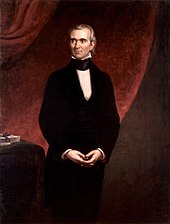
From early in its existence, the speaker's chief function had been to proceed order and enforce rules. The speakership was transformed into a position with power over the legislative procedure nether Henry Dirt (1811–1814, 1815–1820, and 1823–1825).[14] [xv] In contrast to many of his predecessors, Clay participated in several debates and used his influence to procure the passage of measures he supported—for instance, the annunciation of the War of 1812, and various laws relating to Clay's "American Organization" economic programme. Furthermore, when no candidate received an Balloter College majority in the 1824 presidential ballot, causing the president to exist elected by the Business firm, Speaker Dirt threw his support to John Quincy Adams instead of Andrew Jackson, thereby ensuring Adams' victory. Following Clay'due south retirement in 1825, the power of the speakership one time again began to decline, despite speakership elections condign increasingly bitter. Equally the Civil War approached, several sectional factions nominated their own candidates, often making information technology difficult for any candidate to accomplish a majority. In 1855 and again in 1859, for example, the contest for speaker lasted for two months before the House achieved a result. Speakers tended to have very short tenures during this flow. For example, from 1839 to 1863 there were eleven speakers, only 1 of whom served for more than than ane term. To engagement, James G. Polk is the only speaker of the House who was later elected president of the United States.
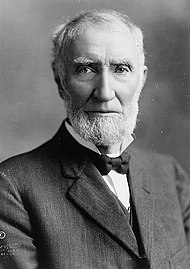
Towards the end of the 19th century, the role of speaker began to develop into a very powerful i. At the time, one of the about important sources of the speaker's power was his position as Chairman of the Committee on Rules, which, subsequently the reorganization of the commission system in 1880, became one of the most powerful continuing committees of the Business firm. Furthermore, several speakers became leading figures in their political parties; examples include Democrats Samuel J. Randall, John Griffin Carlisle, and Charles F. Well-baked, and Republicans James G. Blaine, Thomas Brackett Reed, and Joseph Gurney Cannon.
The power of the speaker was greatly augmented during the tenure of the Republican Thomas Brackett Reed (1889–1891, 1895–1899). "Czar Reed", every bit he was called by his opponents,[sixteen] sought to end the obstruction of bills past the minority, in particular by countering the tactic known every bit the "disappearing quorum".[17] By refusing to vote on a movement, the minority could ensure that a quorum would not be accomplished and that the outcome would be invalid. Reed, however, declared that members who were in the chamber just refused to vote would still count for the purposes of determining a quorum. Through these and other rulings, Reed ensured that the Democrats could not block the Republican calendar.
The speakership reached its apogee during the term of Republican Joseph Gurney Cannon (1903–1911). Cannon exercised extraordinary control over the legislative process. He adamant the agenda of the Business firm, appointed the members of all committees, chose committee chairmen, headed the Rules Committee, and determined which commission heard each bill. He vigorously used his powers to ensure that Republican proposals were passed past the House. In 1910, even so, Democrats and several dissatisfied Republicans joined together to strip Cannon of many of his powers, including the ability to name committee members and his chairmanship of the Rules Committee.[18] Fifteen years later, Speaker Nicholas Longworth restored much, merely not all, of the lost influence of the position.

Sam Rayburn (1940–1947; 1949–1953; and 1955–1961) was the longest serving speaker
One of the most influential speakers in history was Democrat Sam Rayburn.[19] Rayburn had the most cumulative fourth dimension as speaker in history, holding office from 1940 to 1947, 1949 to 1953, and 1955 to 1961. He helped shape many bills, working quietly in the background with House committees. He also helped ensure the passage of several domestic measures and foreign assistance programs advocated by Presidents Franklin D. Roosevelt and Harry Truman.
Rayburn's successor, Democrat John Westward. McCormack (served 1962–1971), was a somewhat less influential speaker, particularly because of dissent from younger members of the Democratic Party. During the mid-1970s, the power of the speakership over again grew under Democrat Carl Albert. The Committee on Rules ceased to be a semi-contained panel, as information technology had been since 1910. Instead, it once again became an arm of the party leadership. Moreover, in 1975, the speaker was granted the authority to engage a majority of the members of the Rules Committee. Meanwhile, the power of commission chairmen was curtailed, farther increasing the relative influence of the speaker.
Albert's successor, Democrat Tip O'Neill, was a prominent speaker because of his public opposition to the policies of President Ronald Reagan. O'Neill is the longest continually serving speaker, from 1977 through 1987. He challenged Reagan on domestic programs and on defense expenditures. Republicans made O'Neill the target of their election campaigns in 1980 and 1982 simply Democrats managed to retain their majorities in both years.
The roles of the parties reversed in 1994 when, after spending forty years in the minority, the Republicans regained control of the House with the "Contract with America", an idea spearheaded by Minority Whip Newt Gingrich. Speaker Gingrich would regularly clash with Democratic President Neb Clinton, leading to the Us federal regime shutdown of 1995 and 1996, in which Clinton was largely seen to have prevailed. Gingrich'south hold on the leadership was weakened significantly by that and several other controversies, and he faced a caucus revolt in 1997. Afterwards the Republicans lost House seats in 1998 (although retaining a majority) he did non correspond a third term equally speaker. His successor, Dennis Hastert, had been chosen as a compromise candidate since the other Republicans in the leadership were more than controversial. Hastert played a much less prominent role than other contemporary speakers, being overshadowed past House Majority Leader Tom DeLay and President George W. Bush. The Republicans came out of the 2000 elections with a further reduced bulk simply fabricated small-scale gains in 2002 and 2004. The periods of 2001–2002 and 2003–2007 were the starting time times since 1953–1955 that at that place was single-party Republican leadership in Washington, interrupted from 2001 to 2003 as Senator Jim Jeffords of Vermont left the Republican Political party to become independent and caucused with Senate Democrats to requite them a 51–49 majority.
In the 2006 midterm elections, the Democrats won a majority in the House. Nancy Pelosi became speaker when the 110th Congress convened on January 4, 2007, making her the commencement woman to hold the function. With the election of Barack Obama every bit president and Democratic gains in both houses of Congress, Pelosi became the first speaker since Tom Foley to hold the part during unmarried-party Autonomous leadership in Washington.[20] During the 111th Congress, Pelosi was the driving force behind several of Obama's major initiatives that proved controversial, and the Republicans campaigned against the Democrats' legislation past staging a "Burn Pelosi" bus bout[21] and regained command of the House in the 2010 midterm elections.[22]
John Boehner was elected speaker when the 112th Congress convened on January five, 2011, and was subsequently re-elected twice, at the commencement of the 113th and 114th Congresses. On both of those occasions his remaining in office was threatened by the revolt of several members from his own party who chose not to vote for him.[23] [24] Boehner's tenure equally speaker, which ended when he resigned from Congress in Oct 2015, was marked by multiple battles with the conservatives in his ain party related to "Obama Intendance," appropriations, amongst other political issues.[25] This intra-party discord continued under Boehner's successor, Paul Ryan.
Post-obit the 2022 midterm elections which saw the election of a Democratic Party majority in the House of Representatives, Nancy Pelosi was elected speaker when the 116th Congress convened on January three, 2019. When Republican leader John Boehner succeeded her as speaker in 2011, Pelosi remained the leader of the Democratic Party in the House of Representatives and served as House minority leader for eight years earlier she led her party to victory in the 2022 elections. In addition to being the starting time woman to hold the office, Pelosi became the outset speaker to render to power since Sam Rayburn in the 1950s.[26]
Notable elections [edit]

Speaker Nancy Pelosi (right) with Vice President Dick Cheney behind President George Westward. Bush at the 2007 State of the Wedlock Address making history every bit the first adult female to sit down behind the podium at such an address. President Bush acknowledged this by outset his speech with the words, "Tonight, I have a high privilege and distinct honor of my own — as the first president to begin the State of the Union message with these words: Madam Speaker".[27]
Historically, at that place have been several controversial elections to the speakership, such as the contest of 1839. In that case, even though the 26th United States Congress convened on December 2, the House could non begin the speakership election until December 14 because of an election dispute in New Jersey known as the "Broad Seal War". Two rival delegations, one Whig and the other Democrat, had been certified as elected by unlike branches of the New Bailiwick of jersey regime. The problem was compounded by the fact that the result of the dispute would determine whether the Whigs or the Democrats held the bulk. Neither political party agreed to permit a speakership election with the reverse party'due south delegation participating. Finally, information technology was agreed to exclude both delegations from the election and a speaker was finally chosen on Dec 17.
Another, more than prolonged fight occurred in 1855 in the 34th United States Congress. The old Whig Political party had collapsed but no unmarried party had emerged to supercede information technology. Candidates opposing the Democrats had run under a bewildering variety of labels, including Whig, Republican, American (Know Nada), and simply "Opposition". By the fourth dimension Congress actually met in December 1855, most of the northerners were concentrated together as Republicans, while most of the southerners and a few northerners used the American or Know Nothing characterization. Opponents of the Democrats held a bulk in Firm, with the party makeup of the 234 representatives being 83 Democrats, 108 Republicans, and 43 Know Nothings (primarily southern oppositionists). The Democratic minority nominated William Alexander Richardson of Illinois as speaker, but because of sectional distrust, the diverse oppositionists were unable to agree on a single candidate for speaker. The Republicans supported Nathaniel Prentice Banks of Massachusetts, who had been elected as a Know Zippo but was now largely identified with the Republicans. The southern Know Nothings supported outset Humphrey Marshall of Kentucky, and then Henry 1000. Fuller of Pennsylvania. The voting went on for most two months with no candidate able to secure a majority, until it was finally agreed to elect the speaker by plurality vote, and Banks was elected.[28] The House constitute itself in a similar dilemma when the 36th Congress met in December 1859. Although the Republicans held a plurality, the Republican candidate, John Sherman, was unacceptable to southern oppositionists due to his anti-slavery views, and once again the House was unable to elect a speaker. Subsequently Democrats centrolineal with southern oppositionists to nearly elect the Northward Carolina oppositionist William North. H. Smith, Sherman finally withdrew in favor of compromise candidate William Pennington of New Jersey, a old Whig of unclear partisan loyalties, who was finally elected speaker on February 1, 1860.[29]
The terminal time that an election for speaker went beyond one ballot was in December 1923 at the starting time of the 68th Congress, when Republican Frederick H. Gillett needed nine ballots to win reelection. Progressive Republicans had refused to back up Gillett in the first eight ballots. But afterward winning concessions from Republican briefing leaders (a seat on the House Rules Committee and a pledge that requested Firm rules changes would be considered) did they concur to support him.[30] [31]
In 1997, several Republican congressional leaders tried to force Speaker Newt Gingrich to resign. However, Gingrich refused since that would have required a new election for speaker, which could accept led to Democrats along with dissenting Republicans voting for Democrat Dick Gephardt (then minority leader) as speaker. Later on the 1998 midterm elections where the Republicans lost seats, Gingrich did not stand for re-election. The next two figures in the Business firm Republican leadership bureaucracy, Majority Leader Richard Armey and Majority Whip Tom Delay chose not to run for the office. The chairman of the House Appropriations Commission, Bob Livingston, declared his bid for the speakership, which was unopposed, making him speaker-designate. It was then revealed, by Livingston himself, who had been publicly critical of President Bill Clinton's perjury during his sexual harassment trial, that he had engaged in an extramarital affair. He opted to resign from the House, despite being urged to stay on by House Democratic leader Gephardt. Afterward, the principal deputy whip Dennis Hastert was selected as speaker. The Republicans retained their majorities in the 2000, 2002, and 2004 elections.
The Democrats won a majority of seats in the 2006 midterm elections. On November xvi, 2006, Nancy Pelosi, who was then minority leader, was selected equally speaker-designate by House Democrats.[32] When the 110th Congress convened on Jan 4, 2007, she was elected as the 52nd speaker by a vote of 233–202, becoming the first woman elected speaker of the House.[33] Pelosi remained speaker through the 111th Congress.
Most recent ballot for speaker (2021) [edit]
The nigh recent ballot for House speaker took place January three, 2021, on the opening day of the 117th The states Congress, two months after the 2022 House elections in which the Democrats won a majority of the seats. Incumbent speaker, Democrat Nancy Pelosi, secured a narrow majority of the 427 votes cast and was elected to a quaternary (second consecutive) term. She received 216 votes to Republican Kevin McCarthy's 209 votes, with ii votes going to other persons; likewise, three representatives answered present when their names were called.[34]
Partisan role [edit]

Paul Ryan taking the oath of role upon condign speaker on October 29, 2015
The Constitution does not spell out the political function of the speaker. As the part has adult historically, still, it has taken on a clearly partisan bandage, very dissimilar from the speakership of well-nigh Westminster-style legislatures, such every bit the speaker of the United Kingdom's House of Commons, which is meant to be scrupulously non-partisan. The speaker in the Us, by tradition, is the caput of the bulk party in the Business firm of Representatives, outranking the majority leader. Even so, despite having the correct to vote, the speaker usually does non participate in debate.
The speaker is responsible for ensuring that the House passes legislation supported by the bulk party. In pursuing this goal, the speaker may use their ability to make up one's mind when each bill reaches the floor. They as well chair the majority party's steering committee in the Firm. While the speaker is the functioning head of the House majority party, the aforementioned is non true of the president pro tempore of the Senate, whose office is primarily ceremonial and honorary.
When the speaker and the president belong to the same party, the speaker tends to play the role in a more ceremonial lite, every bit seen when Dennis Hastert played a very restrained part during the presidency of fellow Republican George West. Bush. Nevertheless, when the speaker and the president belong to the same party, in that location are also times that the speaker plays a much larger office, and the speaker is tasked, e.g., with pushing through the calendar of the majority party, often at the expense of the minority opposition. This tin be seen, most of all, in the speakership of Autonomous-Republican Henry Clay, who personally ensured the presidential victory of swain Democratic-Republican John Quincy Adams. Democrat Sam Rayburn was a key player in the passing of New Deal legislation under the presidency of beau Democrat Franklin Delano Roosevelt. Republican Joseph Gurney Cannon (nether Theodore Roosevelt) was particularly infamous for his marginalization of the minority Democrats and centralizing of authority to the speakership. In more recent times, Speaker Nancy Pelosi played a role in standing the push for health care reform during the presidency of young man Democrat Barack Obama.[35]
On the other hand, when the speaker and the president vest to reverse parties, the public role and influence of the speaker tend to increase. As the highest-ranking member of the opposition party (and de facto leader of the opposition), the speaker is normally the chief public opponent of the president's agenda. In this scenario, the speaker is known for undercutting the president'southward agenda by blocking measures past the minority political party or rejecting bills by the Senate. 1 famous instance came in the form of Thomas Brackett Reed (under Grover Cleveland), a speaker notorious for his successful attempt to force the Democrats to vote on measures where the Republicans had clear majorities, which ensured that Cleveland'due south Democrats were in no position to claiming the Republicans in the House. Joseph Cannon was particularly unique in that he led the conservative "Old Guard" wing of the Republican Party, while his president – Theodore Roosevelt – was of the more progressive clique, and more than merely marginalizing the Democrats, Cannon used his power to punish the dissidents in his party and obstruct the progressive fly of the Republican Party.
More than modern examples include Tip O'Neill, who was a vocal opponent of President Ronald Reagan's economic and defense force policies; Newt Gingrich, who fought a bitter battle with President Bill Clinton for command of domestic policy; Nancy Pelosi, who argued with President George West. Bush-league over the Republic of iraq War;[22] John Boehner, who clashed with President Barack Obama over budget problems and wellness intendance;[36] and once again, Nancy Pelosi, who refused to support Donald Trump over funding for a border wall.[37]
Presiding officeholder [edit]
As presiding officer of the House of Representatives, the speaker holds a variety of powers over the Business firm and is ceremonially the highest-ranking legislative official in the United states authorities.[38] The speaker may delegate their powers to a member of the House to human activity as speaker pro tempore and to preside over the House in the speaker's absence; when this has occurred the delegation has ever been to a fellow member of the same party.[39] During important debates, the speaker pro tempore is ordinarily a senior member of the majority party who may be chosen for his or her skill in presiding. At other times, more junior members may exist assigned to preside to give them experience with the rules and procedures of the House. The speaker may as well designate, with approving of the House, a speaker pro tempore for special purposes, such as designating a representative whose district is near Washington, D.C. to sign enrolled bills during long recesses.
Under the rules of the House, the speaker, "as shortly as practicable later on the election of the speaker and whenever appropriate thereafter", must deliver to the clerk of the House a confidential listing of members who are designated to act every bit speaker in the case of a vacancy or physical inability of the speaker to perform their duties.[40]
On the floor of the House, the presiding officer is always addressed as "Mister Speaker" or "Madam Speaker", even if that person is serving as speaker pro tempore. When the Firm resolves itself into a Committee of the Whole, the speaker designates a fellow member to preside over the committee, who is addressed as "Mister Chairman" or "Madam Chairwoman". To speak, members must seek the presiding officer'south recognition. The presiding officer as well rules on all points of order but such rulings may be appealed to the whole House. The speaker is responsible for maintaining decorum in the House and may order the Sergeant-at-Artillery to enforce House rules.
The speaker's powers and duties extend beyond presiding in the chamber. In particular, the speaker has bully influence over the committee procedure. The speaker selects nine of the thirteen members of the powerful Committee on Rules, discipline to the blessing of the entire majority party. The leadership of the minority party chooses the remaining four members. Furthermore, the speaker appoints all members of select committees and conference committees. Moreover, when a bill is introduced, the speaker determines which committee will consider it. As a member of the House, the speaker is entitled to participate in fence and to vote. Ordinarily, the speaker votes only when the speaker'southward vote would exist decisive or on matters of great importance, such equally constitutional amendments or major legislation.[41] Under the early rules of the House, the speaker was mostly barred from voting, just today the speaker has the aforementioned right as other members to vote but merely occasionally exercises it. The speaker may vote on any affair that comes before the House, and they are required to vote where their vote would exist decisive or where the House is engaged in voting by ballot.[42]
Other functions [edit]

The speaker'southward office in the United states Capitol, during the term of Dennis Hastert (1999–2007)
In addition to being the political and parliamentary leader of the House of Representatives and representing their congressional commune, the speaker also performs various other administrative and procedural functions, such every bit:
- Oversees the officers of the House: the clerk, the sergeant-at-arms, the main administrative officer, and the clergyman;
- Serves as the chairperson of the House Office Building Commission;[43]
- Appoints the House's parliamentarian,[44] historian, general counsel, and inspector full general;[45]
- Administers the Business firm audio and video broadcasting organization
- In consultation with the minority leader, tin devise a system of drug testing in the House.[43] This option has never been exercised.[46]
- Receives reports or other communications from the president, government agencies, boards, and commissions.[43]
- Receives, along with the president pro tempore of the Senate, written declarations that a U.S. president is unable to discharge the powers and duties of his office, or is able to resume them, under Sections 3 and 4 of the 20-fifth Amendment.[47]
Additionally, the speaker is 2d in the presidential line of succession under the Presidential Succession Human action of 1947, immediately afterwards the vice president and before the president pro tempore of the Senate (who is followed by members of the president'due south Cabinet). Thus, if both the presidency and vice-presidency were vacant simultaneously, then the speaker would get acting president, after resigning from the House and as speaker.[48]
Ratification of the Xx-fifth Amendment in 1967, with its mechanism for filling an intra-term vice-presidential vacancy, has made calling on the speaker, president pro tempore, or a cabinet fellow member to serve as acting president unlikely to happen, except in the aftermath of a catastrophic event.[48] Even so, but a few years after it went into effect, in October 1973, at the height of Watergate, Vice President Spiro Agnew resigned. With Agnew's unexpected deviation and the state of Richard Nixon's presidency, Speaker Carl Albert was all of a sudden commencement in line to go interim president. The vacancy continued until Gerald Ford was sworn in as vice president on December 6, 1973.[49] Albert was also adjacent in line from the time Ford assumed the presidency on Baronial ix, 1974, following Nixon's resignation from role, until Ford'southward choice to succeed him as vice president, Nelson Rockefeller, was confirmed past Congress four months later.[48]
See also [edit]
- Party leaders of the Usa Firm of Representatives
- Party leaders of the The states Senate
References [edit]
- ^ a b "Speaker Elections Decided by Multiple Ballots". history.business firm.gov. U.s.a. House of Representatives. Archived from the original on March 27, 2019. Retrieved January 22, 2019.
- ^ a b Relyea, Harold C. (Baronial 5, 2005). "Continuity of Regime: Current Federal Arrangements and the Future" (PDF). CRS Report for Congress. Washington, D.C.: Congressional Research Service, the Library of Congress. pp. ii–4. Archived (PDF) from the original on Jan xiv, 2021. Retrieved January 22, 2019.
- ^ Brudnick, Ida A. (January 4, 2012). "Congressional Salaries and Allowances" (PDF). CRS Report for Congress. United states of america Firm of Representatives. Archived from the original (PDF) on February 12, 2019. Retrieved December 2, 2012.
- ^ Heitshusen, Valerie (May 16, 2017). The Speaker of the House: Firm Officeholder, Party Leader, and Representative (PDF) (Study). Congressional Research Service. p. ii. Archived (PDF) from the original on January fourteen, 2021. Retrieved September 20, 2020.
In fact, at that place is no requirement that the Speaker exist a Member of the Business firm.
- ^ Fram, Alan (January 3, 2021). "Pelosi narrowly reelected speaker, faces hard 2021". AP News. Archived from the original on January xiv, 2021. Retrieved January 3, 2021.
- ^ Forte, David F. "Essays on Commodity I: Speaker of the Business firm". Heritage Guide to The Constitution. Heritage Foundation. Archived from the original on August 22, 2020. Retrieved January 11, 2019.
- ^ a b c Heitshusen, Valerie; Beth, Richard Due south. (Jan 4, 2019). "Speakers of the Business firm: Elections, 1913–2019" (PDF). CRS Report for Congress. Washington, D.C.: Congressional Inquiry Service, the Library of Congress. Archived (PDF) from the original on January 14, 2021. Retrieved Jan 11, 2019.
- ^ Grier, Peter (September 25, 2015). "John Boehner exit: Anyone can run for House speaker, even y'all". The Christian Science Monitor. Archived from the original on November 25, 2018. Retrieved January 11, 2019.
- ^ Schudel, Matt (September 27, 2014). "James A. Traficant Jr., colorful Ohio congressman expelled by House, dies at 73". The Washington Postal service. Archived from the original on August 12, 2015. Retrieved Jan 11, 2019.
- ^ "Fathers/Deans of the Firm". history.house.gov. Usa House of Representatives. Archived from the original on January 12, 2019. Retrieved January eleven, 2019.
- ^ "Election of the Speaker Overview". constitution.laws.com. Archived from the original on Baronial 27, 2019. Retrieved January eleven, 2019.
- ^ "List of Speakers of the Business firm". history.business firm.gov. United States House of Representatives. Archived from the original on Jan 14, 2021. Retrieved January 11, 2019.
- ^ Peart, Daniel (2021). "Rethinking the Role of the Speaker: Power, Institutional Development, and the Myth of the "Impartial Moderator" in the Early United states House of Representatives". Periodical of Policy History. 33 (i): 1–31. doi:10.1017/S0898030620000226. ISSN 0898-0306. S2CID 231694119. Archived from the original on February 2, 2021. Retrieved March xi, 2021.
- ^ C. Stewart III, "Architect or tactician? Henry Dirt and the institutional evolution of the US House of Representatives" 1998, online Archived January fourteen, 2021, at the Wayback Car
- ^ "Henry Clay (1825–1829)". U.Due south. Presidents. Charlottesville, Virginia: Miller Center of Public Affairs, University of Virginia. Oct 4, 2016. Archived from the original on May 10, 2021. Retrieved May 10, 2021.
- ^ Robinson, William A. "Thomas B. Reed, Parliamentarian". The American Historical Review, October 1931. pp. 137–138.
- ^ Oleszek, Walter J. (Dec 1998). "A Pre-Twentieth Century Await at the House Committee on Rules". U.Southward. House of Representatives. Archived from the original on Baronial 25, 2005. Retrieved July v, 2007.
- ^ Jones, Charles O. (Baronial 1968). "Joseph G. Cannon and Howard W. Smith: An Essay on the Limits of Leadership in the Firm of Representatives". The Periodical of Politics. xxx (3): 617–646. doi:ten.2307/2128798. JSTOR 2128798. S2CID 154012153.
- ^ "Sam Rayburn Business firm Museum". Texas Historical Commission. Archived from the original on July 1, 2007. Retrieved July 5, 2007.
- ^ See Party Divisions of United States Congresses
- ^ Condon, Stephanie (August six, 2010). "GOP to Launch "Fire Pelosi" Charabanc Bout". CBS News. Archived from the original on February 14, 2011. Retrieved February 11, 2011.
- ^ a b Sanchez, Ray (Nov 3, 2010). "Nancy Pelosi: House Speaker'due south Exclusive Interview With Diane Sawyer". ABC News. Archived from the original on June fifteen, 2011. Retrieved December 6, 2011.
- ^ Cohen, Micah (January iv, 2013). "Were the G.O.P. Votes Against Boehner a Historic Rejection?". The New York Times. Archived from the original on January 14, 2021. Retrieved March 1, 2019.
- ^ Walsh, Deirdre (January half-dozen, 2015). "Boehner Overcomes Big Opposition to Remain Speaker". CNN. Archived from the original on January 29, 2015. Retrieved March i, 2019.
- ^ Shesgreen, Deirdre; Allen, Cooper (September 25, 2015). "Speaker John Boehner to resign from Congress". USA Today. Archived from the original on Jan 14, 2021. Retrieved February 4, 2019.
- ^ Wire, Sarah D. (Jan iii, 2019). "Nancy Pelosi regains the House speaker's gavel as Democrats confront Trump over fractional shutdown". The Denver Post. Archived from the original on January 14, 2021. Retrieved September 28, 2019.
- ^ Bush, George W. (Jan 23, 2007). "President Bush-league Delivers Country of the Marriage Address". The White Business firm. Archived from the original on May 2, 2013. Retrieved August 26, 2007.
- ^ Allan Nevins. Ordeal of the Matrimony, Volume 2: A Business firm Dividing 1852–1857 (New York, 1947), 413–415.
- ^ Allan Nevins. The Emergence of Lincoln, Volume II: Prologue to Civil War, 1859–1861 (New York, 1950), 116–123.
- ^ Wolfensberger, Don (Dec 12, 2018). "Opening solar day of new Congress: Not always full joy". The Hill. Archived from the original on January 14, 2021. Retrieved March 1, 2019.
- ^ Blake, Blake (January six, 2015). "John Boehner simply endured the biggest revolt against a House speaker in more than than 150 years". The Washington Post. Archived from the original on January 14, 2021. Retrieved March 1, 2019.
- ^ San Francisco Commission on the Condition of Women Archived September 30, 2007, at the Wayback Auto. City & County of San Francisco, Nov sixteen, 2006. Retrieved on July five, 2007.
- ^ John Grand. Broder (January five, 2007). "Jubilant Democrats Assume Control on Capitol Hill". The New York Times. Archived from the original on Jan xiv, 2021. Retrieved February 8, 2018.
- ^ Fram, Alan (January 3, 2021). "Pelosi narrowly reelected House speaker; Slotkin voted 'present'". The Detroit News. AP. Archived from the original on January fourteen, 2021. Retrieved January four, 2021.
- ^ Thrush, Glenn; Brown, Carrie Budoff (March 20, 2010). "Nancy Pelosi steeled White House for health push – Carrie Budoff Brownish and Glenn Thrush". Politician. Archived from the original on January 14, 2021. Retrieved December vi, 2011.
- ^ Hurst, Steven R. (Jan 5, 2011). "Republicans have charge of The states House, poised for clashes with Obama over spending, wellness intendance". 1310 News. Archived from the original on May x, 2011. Retrieved January 7, 2011.
- ^ "Nancy Pelosi: Border wall is 'immoral, expensive, unwise'". NBC News. Archived from the original on January 14, 2021. Retrieved October 29, 2019.
- ^ Speaker of the Firm Law & Legal Definition Archived 2021-01-14 at the Wayback Machine. Retrieved March 16, 2015.
- ^ Speaker Pro Tempore Law & Legal Definition Archived 2021-01-14 at the Wayback Machine. Retrieved March 16, 2015.
- ^ "Rules of the House of Representatives" (PDF). Jan 6, 2015. Archived from the original on October 5, 2015. Retrieved October 21, 2015.
- ^ Americapedia: Taking the Impaired Out of Freedom Jodi Lynn Anderson, Daniel Ehrenhaft & Andisheh Nouraee 2011, Bloomsbury Publishing Page 26.
- ^ "Firm Practice: A Guide to the Rules, Precedents and Procedures of the House]". gpo.gov. U.S. Government Publishing Function. Archived from the original on May four, 2021. Retrieved April thirteen, 2021.
- ^ a b c Heitshusen, Valerie (May 16, 2017). "The Speaker of the House: House Officeholder, Party Leader, and Representative". CRS Study for Congress RL97-780. Washington, D.C.: Congressional Research Service, Library of Congress. Archived from the original on January xiv, 2021. Retrieved January 22, 2019.
- ^ "Parliamentarians of the House". history.house.gov. United States Firm of Representatives. Archived from the original on Jan 14, 2021. Retrieved January 22, 2019.
- ^ Forte, David F. "Essays on Article I: Speaker of the House". The Heritage Guide to The Constitution. The Heritage Foundation. Archived from the original on August 22, 2020. Retrieved Jan 22, 2019.
- ^ "Will members of Congress always drug-examination themselves? They've certainly tried". Roll Call. Feb 22, 2019. Archived from the original on November 16, 2020. Retrieved November 15, 2020.
- ^ Neale, Thomas H. (Nov 5, 2018). "Presidential Disability Under the Xx-Fifth Amendment: Constitutional Provisions and Perspectives for Congress" (PDF). CRS Report for Congress R45394. Washington, D.C.: Congressional Enquiry Service, the Library of Congress. Archived (PDF) from the original on November eight, 2018. Retrieved Jan 22, 2019.
- ^ a b c Neale, Thomas H. (June 29, 2005). "Presidential Succession: An Overview with Analysis of Legislation Proposed in the 109th Congress" (PDF). CRS Study for Congress RL32969. Washington, D.C.: Congressional Inquiry Service, the Library of Congress. pp. 4–6. Archived (PDF) from the original on January fourteen, 2021. Retrieved January 22, 2019.
- ^ Gup, Ted (Nov 28, 1982). "Speaker Albert Was Ready to Be President". The Washington Mail. Archived from the original on Jan 14, 2021. Retrieved January 22, 2019.
Bibliography [edit]
- Garraty, John, ed. American National Biography (1999) 20 volumes; contains scholarly biographies of all speakers no longer alive.
- Green, Matthew N. The Speaker of the House: A Written report of Leadership (Yale University Press; 2010) 292 pages; Examines partisan pressures and other factors that shaped the leadership of the speaker of the U.S. House of Representatives; focuses on the period since 1940.
- Grossman, Marking. Speakers of the House of Representatives (Amenia, NY: Grey Firm Publishing, 2009). The comprehensive work on the subject, covering, in depth, the lives of the speakers from Frederick Muhlenberg to Nancy Pelosi.
- Heitshusen, Valerie (Nov 26, 2018). "Speakers of the Firm: Elections, 1913–2017" (PDF). Congressional Research Service. Retrieved December 18, 2018.
- Remini, Robert V. The Business firm: the History of the Firm of Representatives (Smithsonian Books, 2006). The standard scholarly history.
- Rohde, David W. Parties and Leaders in the Postreform House (1991).
- Smock, Raymond W., and Susan Due west. Hammond, eds. Masters of the House: Congressional Leadership Over Two Centuries (1998). Brusk biographies of fundamental leaders.
- Zelizer. Julian E. ed. The American Congress: The Building of Democracy (2004). A comprehensive history by twoscore scholars.
External links [edit]
- "Capitol Questions." C-Span (2003). Notable elections and role.
- The Cannon Centenary Conference: The Changing Nature of the Speakership. (2003). House Document 108–204. History, nature and role of the speakership.
- Congressional Quarterly's Guide to Congress, 5th ed. (2000). Washington, D.C.: Congressional Quarterly Press.
- Wilson, Woodrow. (1885). Congressional Government. New York: Houghton Mifflin.
mcdanielwhistless76.blogspot.com
Source: https://en.wikipedia.org/wiki/Speaker_of_the_United_States_House_of_Representatives#:~:text=The%20speaker%20is%20second%20in,Democrat%20Nancy%20Pelosi%20of%20California.

Post a Comment for "Whos in Charge of the House of Representatives"